Best sunset spots in Split: where we actually go
A problem most cities would envy
Split has an embarrassment of sunset options. The city faces roughly southwest, which means the Adriatic acts as a mirror for the evening light. On clear evenings, the last hour before sunset turns the water a specific orange-copper that’s genuinely difficult to photograph well because camera sensors keep trying to correct for what they assume is overexposure.
We’ve watched the sunset from a lot of places in this city over multiple visits. Here’s where we keep returning to, and where we’ve stopped going.
| Best overall | Marjan Hill western ridge (free, 25–35 min walk) |
| Easiest access | Old town rooftops or the Vestibule, no walk required |
| Best value drink | Kila terrace, around €4–5 for a local lager |
| Avoid | Riva cafés at peak summer (crowded, around €9/beer) |
| Best months | June–September for warm, lingering golden hour |
1. Marjan Hill: the honest choice
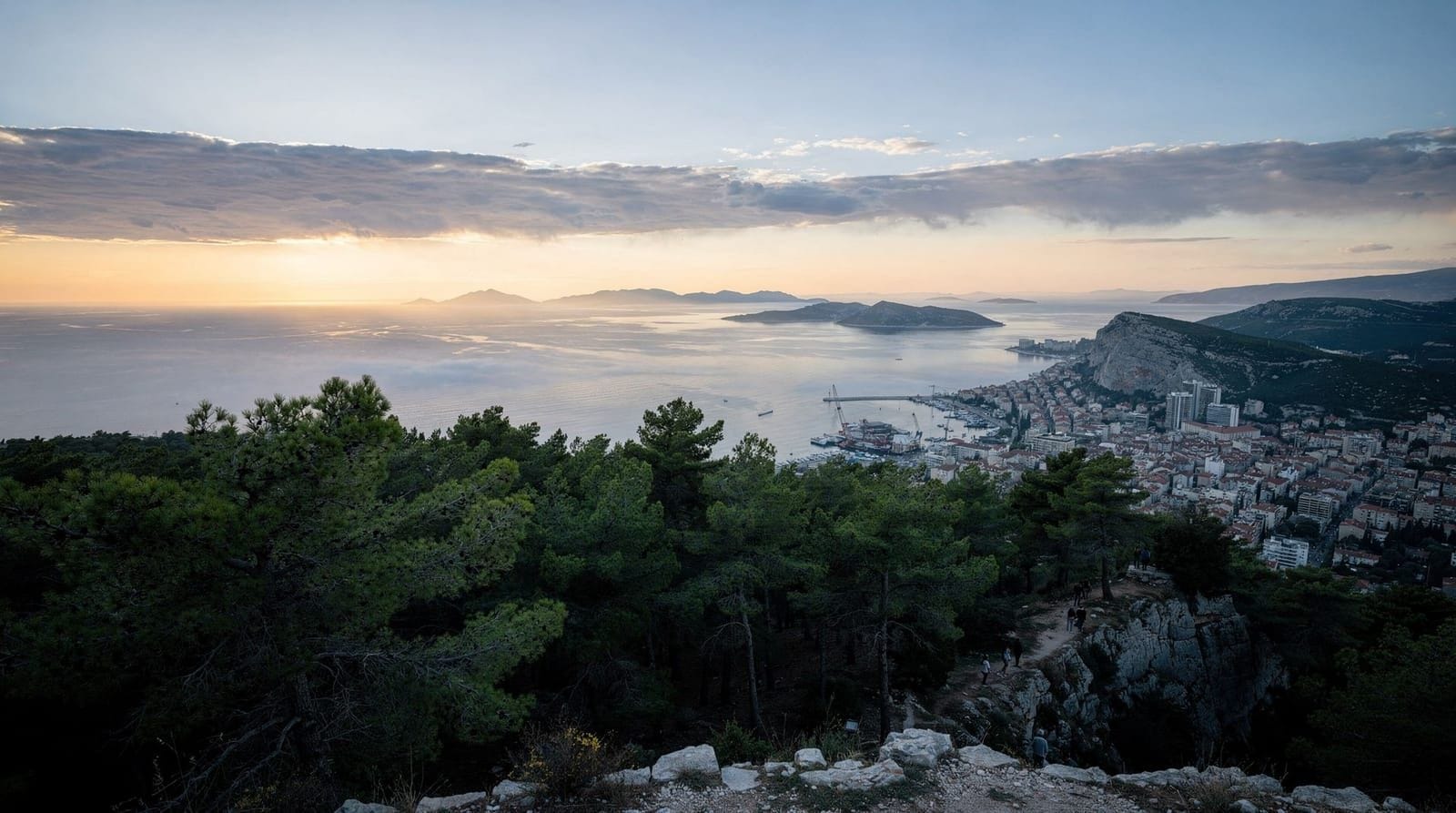
The western ridge of Marjan — the forested peninsula jutting into the Adriatic from the western edge of the old town — gives you what is probably the best unobstructed sunset view in Split. You’re elevated (around 178 m at the summit, though the most useful viewpoints are on the western face well below that), the sea fills the entire western horizon, and on clear evenings you can see the silhouettes of the outer islands, including Šolta and the eastern end of Brač.
The walk from the main Marjan trailhead at Šperun to the best western viewpoints takes about 25–35 minutes at a moderate pace. The path is well-maintained, shaded for most of its length, and free. There’s no entry fee and no queue. At sunset on an average weekday, you’ll share the viewpoints with a handful of other people — mostly locals, some running, some just sitting.
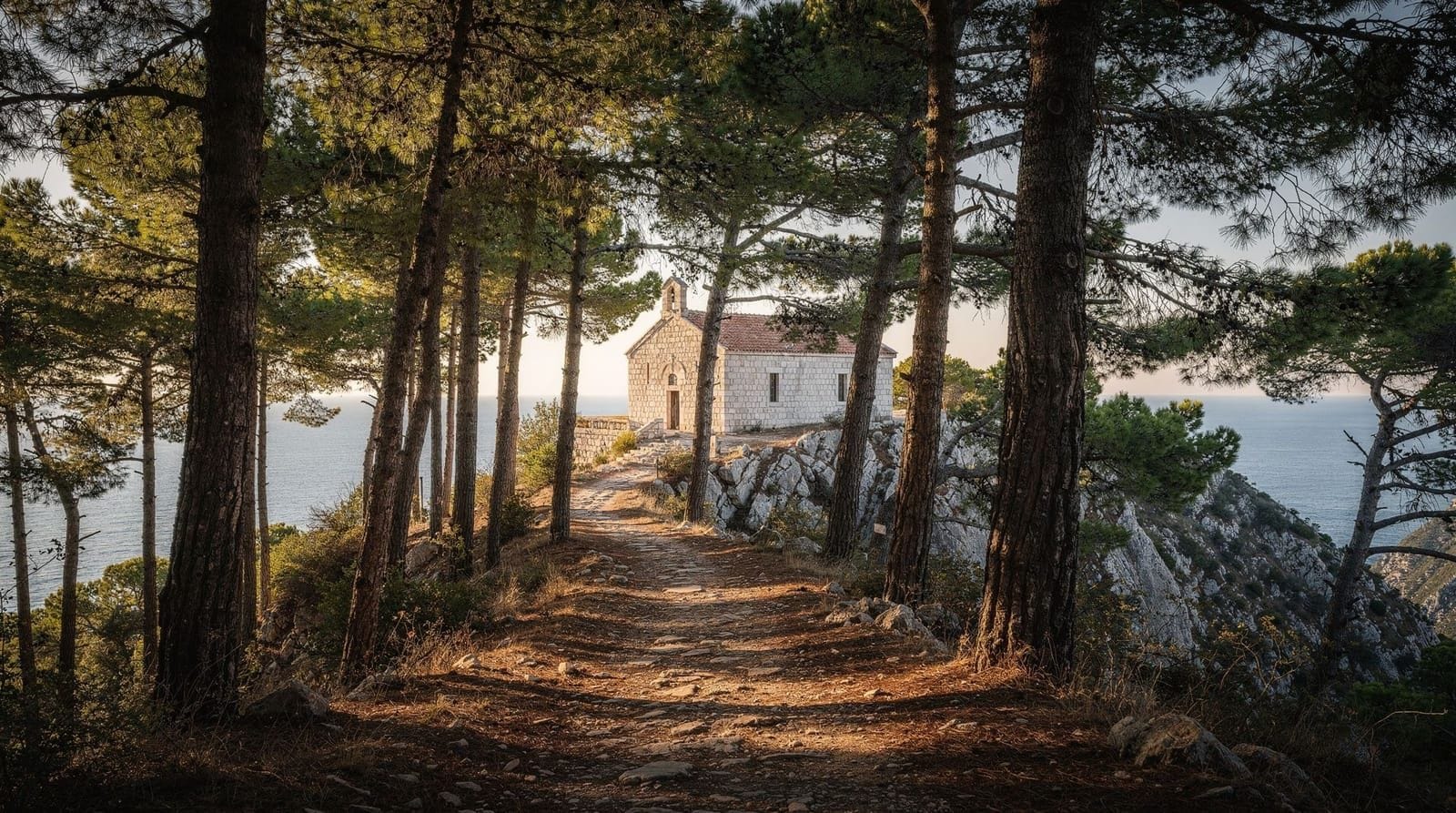
The specific lookout we use most is the terrace platform on the northwest face near the chapel of St. Nikola. It faces almost directly west across open water, has a low stone wall you can sit on, and has enough room that even if a dozen people are there it doesn’t feel crowded.
Bring a light jacket — the hill creates its own small microclimate and the air temperature drops noticeably after the sun dips.
For the route and full trail details, see our Marjan Hill hiking guide. Our separate piece on Marjan at dawn covers the early-morning version of the same walk if you want to compare the light. If you’d rather understand the whole peninsula — the pine forest, the beaches on its southern flank, the old Jewish cemetery — before deciding which viewpoint to walk to, our Marjan destination overview lays it all out.
For photographers specifically: the western viewpoints face almost due west with open sea in front of you, so there’s no scrambling for an unobstructed angle the way there is on the Riva. Bring a small tripod if you shoot long exposures — the stone wall at the St. Nikola terrace is a stable base without one, but a tripod gives you options once light drops below what a phone handles well. Arrive at least 20 minutes before golden hour if you want a spot on the wall; it fills in gradually rather than all at once.
2. The ferry pier, West Harbour
The least scenic on this list visually, but worth mentioning for a specific reason: it’s the only spot where you can watch the sun go down over open water while having a drink in your hand from a café with chairs. The stretch of the harbour just west of the main ferry terminal — the area where the Jadrolinija vessels dock for Šolta and some island routes — has a few informal spots where locals gather for the evening.
The view is partly obstructed by boats and infrastructure, but on evenings when the harbour is quiet between ferry movements, there’s something very particular about watching the light die on the water from a working port. It’s less photogenic than Marjan. It feels more like the city.
3. The Vestibule opening, Diocletian’s Palace
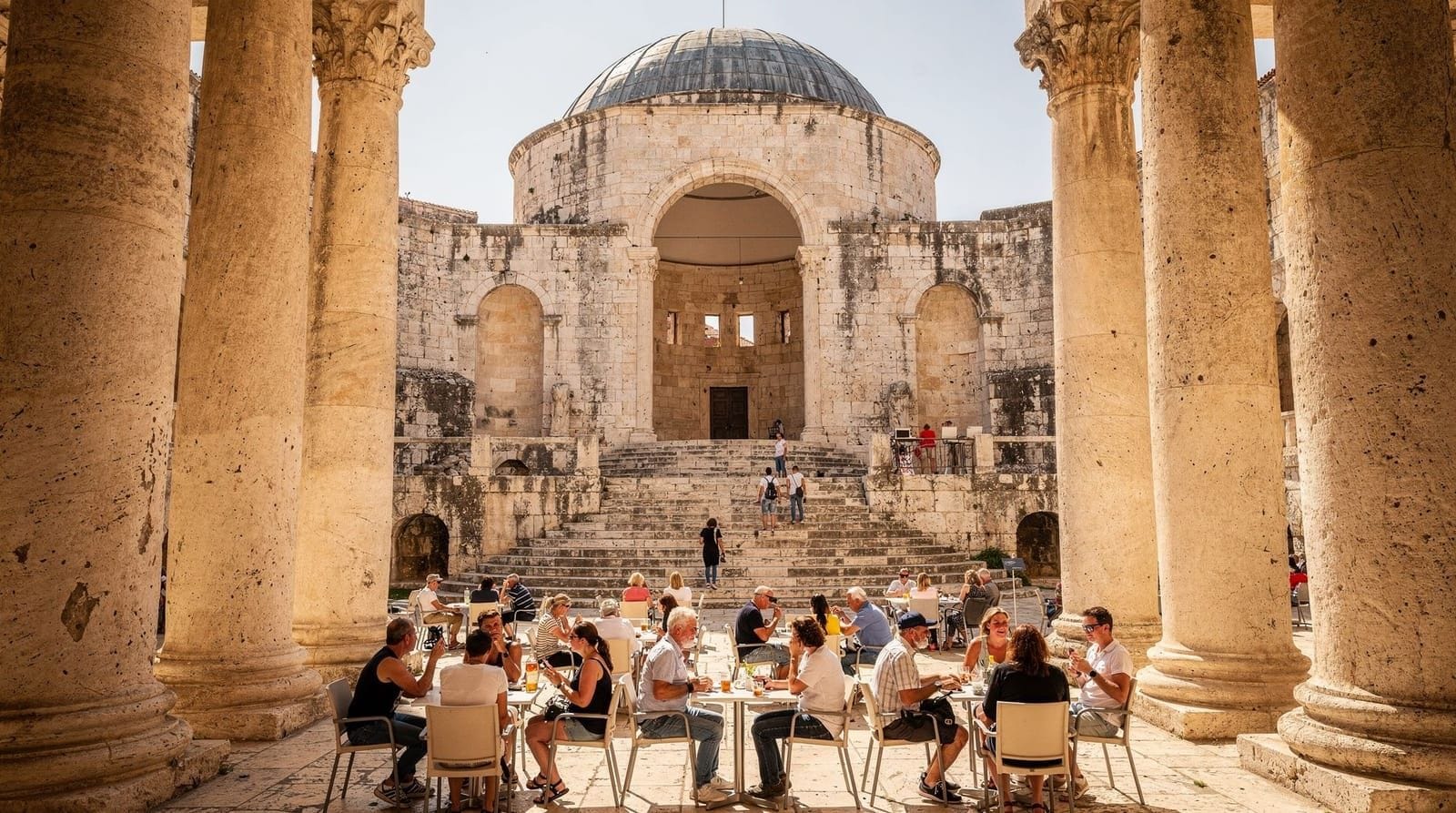
The Vestibule is a domed rotunda at the south end of the Peristyle, now open to the sky. It’s famous as a morning-light location — the circular opening frames the blue above — but the same geometry creates a warm amber glow in the late afternoon as the sun moves to the southwest.
You can’t “watch” the sunset from here because the structure is enclosed on three sides. But if you time your late-afternoon old town visit correctly — roughly 5:30–7 p.m. in summer — the Vestibule fills with low orange light that’s extraordinary to stand in. It’s fleeting, about twenty minutes, and then it’s gone.
The Peristyle directly outside also gets beautiful evening light. The cathedral’s carved stone facade goes golden. The marble pavement reflects the sky. If you’re in the old town anyway, don’t rush back to your accommodation at 6 p.m. — walk through the palace slowly between 5:30 and 7:30 and the architecture rewards you.
For context on the palace itself, see our Diocletian’s Palace guide.
4. Bačvice beach, looking northwest
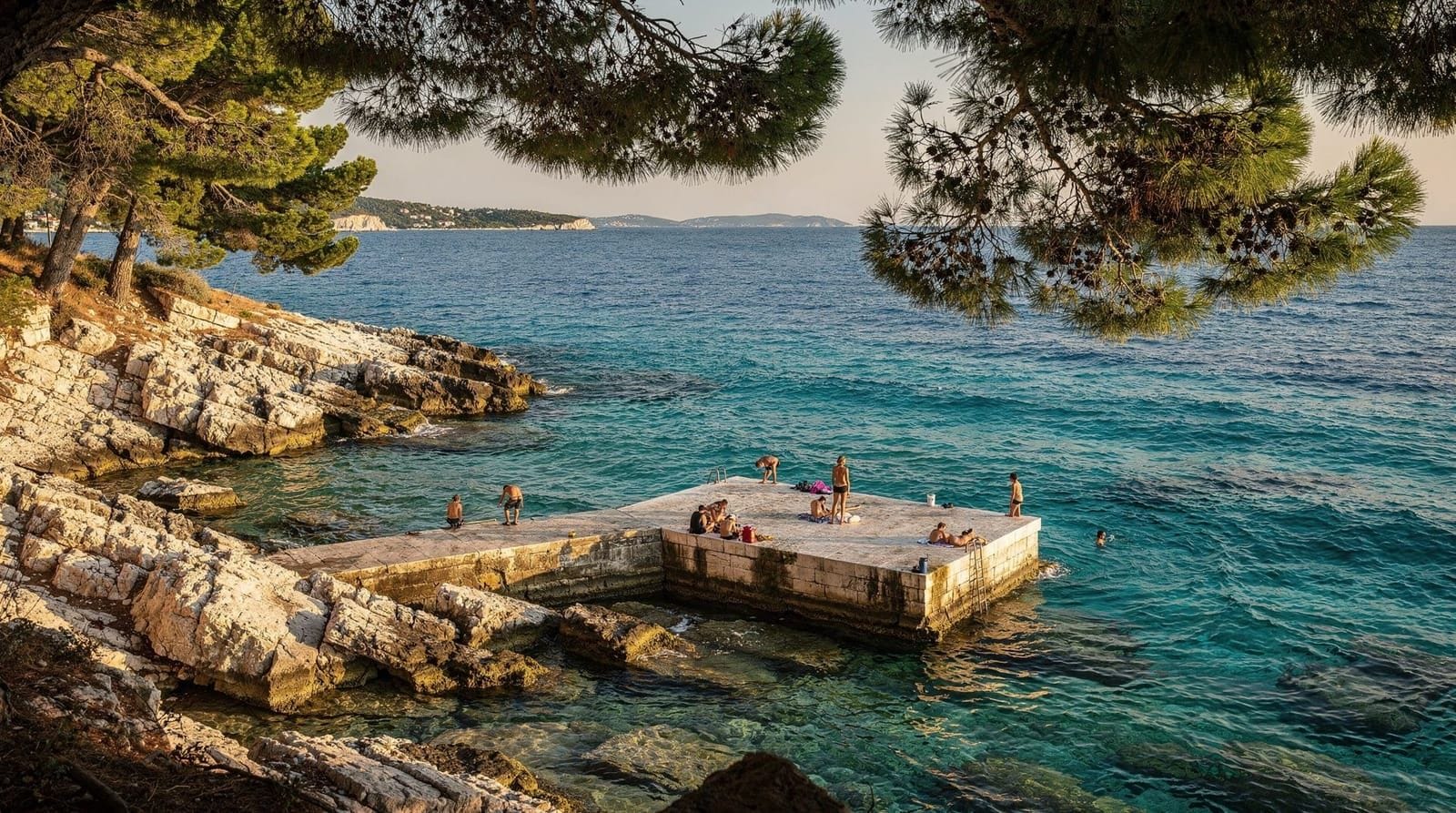
Bačvice — the small sandy (technically fine-pebble) beach a ten-minute walk east of the old town — is not a sunset spot in the strict directional sense. The sun sets to the west, and from Bačvice’s promenade you’re looking north-northwest. But the evening light on the sea from Bačvice is soft and warm in summer, and the beach itself has a particular atmosphere at 7 p.m. — families leaving, a few people still swimming, the concrete promenade bars opening their chairs.
We wouldn’t take a taxi specifically to Bačvice for sunset, but if you’re there for a late swim in summer, stay for the light. It’s a different quality of beauty from Marjan — more human, more lived-in.
5. Kila café terrace, Marjan lower road
Halfway up the approach to Marjan, on the road that wraps around the hill’s southern face, there’s a small bar called Kila (or similar — it’s changed names in the past) with an outdoor terrace that looks south over the water toward the islands. It’s popular with locals and not with most tourists, partly because you have to know to walk around the hill rather than straight up it.
The advantage here is that you can watch the light fade with a beer in hand (local craft lager runs about €4–5) and not have to walk back down in the dark. The disadvantage is it gets crowded on Friday and Saturday evenings in summer — it’s a local favourite — so arrive early.
6. The rooftops — if you can access them
A number of apartment rentals and small boutique hotels in the old town have roof terraces. These vary dramatically in quality and view, but a good old-town rooftop looks west over the jumble of terracotta tiles and out to sea. If you’re booking accommodation in Split, a rooftop terrace is worth prioritising for this specific reason. Check the property photos and ask the host explicitly.
The one we’ve used with the best sunset view is a private apartment in the northwest corner of the palace complex. We can’t name it here specifically, but it’s worth searching Airbnb or direct booking platforms filtering by “terrace” in the Diocletian’s Palace/Stari Grad neighbourhood.
Sunset boat cruises: skip them or book them?
There’s a whole industry of evening boat trips out of Split’s harbour, and we get asked constantly whether they’re worth it over just picking a spot on land. Our honest answer: it depends what you want. A land viewpoint like Marjan is free, flexible, and gives you a fixed, stable frame to shoot or just sit with a drink. A boat gives you open water in every direction, the city skyline receding behind you, and — on the better trips — a stop for swimming before the light goes.
Split Riviera sunset cruise with swim stopIf you want something a bit livelier, a handful of operators run boats with music and drinks included, which suits a group better than a quiet couple’s evening.
Split sunset cruise with live musicNeither is “better” than Marjan — they’re different experiences. We’d book a boat once per trip for the novelty of the skyline view, and use Marjan or the old town for every other evening. If you’re weighing a full-day sail against a short sunset trip, our sailing the Adriatic guide covers the longer options.
Where to base yourself if sunset access matters to you
If watching the sun go down without a walk or a taxi ride matters to your trip, it’s worth factoring into where you book accommodation, not just where you go each evening. The old town itself gives you rooftop-terrace odds and a two-minute stroll to the Peristyle for the Vestibule light. Staying on the Marjan side of the peninsula (west of the old town, around Meje or Sperun) puts you closest to the hiking trailhead, which matters if you want to go up more than once. Our where to stay in Split guide breaks down neighbourhoods in more detail, and our Split old town walking guide is useful for working out how the streets connect if you’re new to the layout.
What to avoid
The Riva cafés. Yes, they face southwest. Yes, the view is technically good. But the tourist-bar surcharge for Riva seating means you’ll pay €9 for a beer to watch a sunset that you could watch better from Marjan for free. The cocktail bars on the waterfront also get very crowded at 7 p.m. in summer, which means you spend the golden hour negotiating seating rather than watching the light.
We’ve done the Riva sunset. It’s not bad. It’s just not the best version of this city.
Timing reference
Sunset times in Split by month, and when to arrive to catch the full golden hour before it:
| Month | Sunset (approx.) | Arrive by |
|---|---|---|
| May | around 8:00 p.m. | 7:00 p.m. |
| June–July | around 8:30–8:45 p.m. | 7:30 p.m. |
| August | around 8:00–8:15 p.m. | 7:00–7:15 p.m. |
| September | around 7:15–7:30 p.m. | 6:15–6:30 p.m. |
The best light — the “golden hour” — typically begins 45–60 minutes before these times, which is why the “arrive by” column sits well ahead of sunset itself, not right at it. Shoulder-season months (May, late September) also mean fewer people at Marjan’s western terrace, so you get the same light with more room to yourself.
For more on walking and spending time in Split’s neighbourhoods, see our getting around Split guide and our Split destination overview.