Mostar in a day from Split: what we found, what to skip
Why Mostar makes it onto most itineraries
Bosnia is about two hours from Split by road. This proximity — combined with the extraordinary visual impact of Mostar’s rebuilt Ottoman bridge and the Neretva River — makes the Mostar day trip one of the most popular excursions on the entire Dalmatian coast.
We’d done it on tour (first visit, organised by a Split operator) and independently by rental car (second visit). Both worked, for different reasons. Here’s the full picture of what the day involves and how to make it work.
| Distance | around 150 km, 2–2.5 hrs each way from Split |
| Cost (organised tour) | around €50–70/person, incl. transport and guide |
| Cost (self-drive + Kravica) | around €25–40/person for fuel, tolls and entry fees |
| Time needed | a full day, roughly 11–12 hours door to door |
| Border | EU/UK/US/Canadian/Australian citizens: passport only, no visa |
| Best paired with | Kravica Waterfalls (see below) |
The logistics reality
The drive from Split to Mostar is about 150 km and takes 2–2.5 hours depending on traffic and border crossing. You exit Croatia, cross briefly through Bosnia (there’s a 9 km stretch of Bosnia between Ploče and Neum that you pass even on the coast road to Dubrovnik), and then proceed to Mostar.
If you’re on an organised tour, the operator handles all of this — the routing, the border paperwork for the group, and any complications. For independent travelers with a rental car, the crossing is simpler than it sounds. EU, UK, US, Canadian, and Australian citizens don’t need a visa for Bosnia. You slow down, show your passport, and continue. The crossing takes 5–10 minutes in our experience, occasionally 20–30 in summer when traffic backs up.
Fuel: prices in Bosnia are slightly lower than Croatia. If you’re driving and your tank isn’t full, it’s worth noting.
Currency: Bosnia uses the Convertible Mark (BAM). As of 2026, 1 EUR is approximately 1.96 BAM — it’s fixed to the euro at essentially 2:1. Many tourist-facing places in Mostar’s old town accept euros, though you’ll get better change in BAM. There are ATMs in the old town. Do not bring Croatian kuna — it hasn’t been valid since Croatia adopted the euro in 2023.
Book a Mostar and Kravica Waterfalls day tour from SplitThe Old Bridge and old town: what to expect
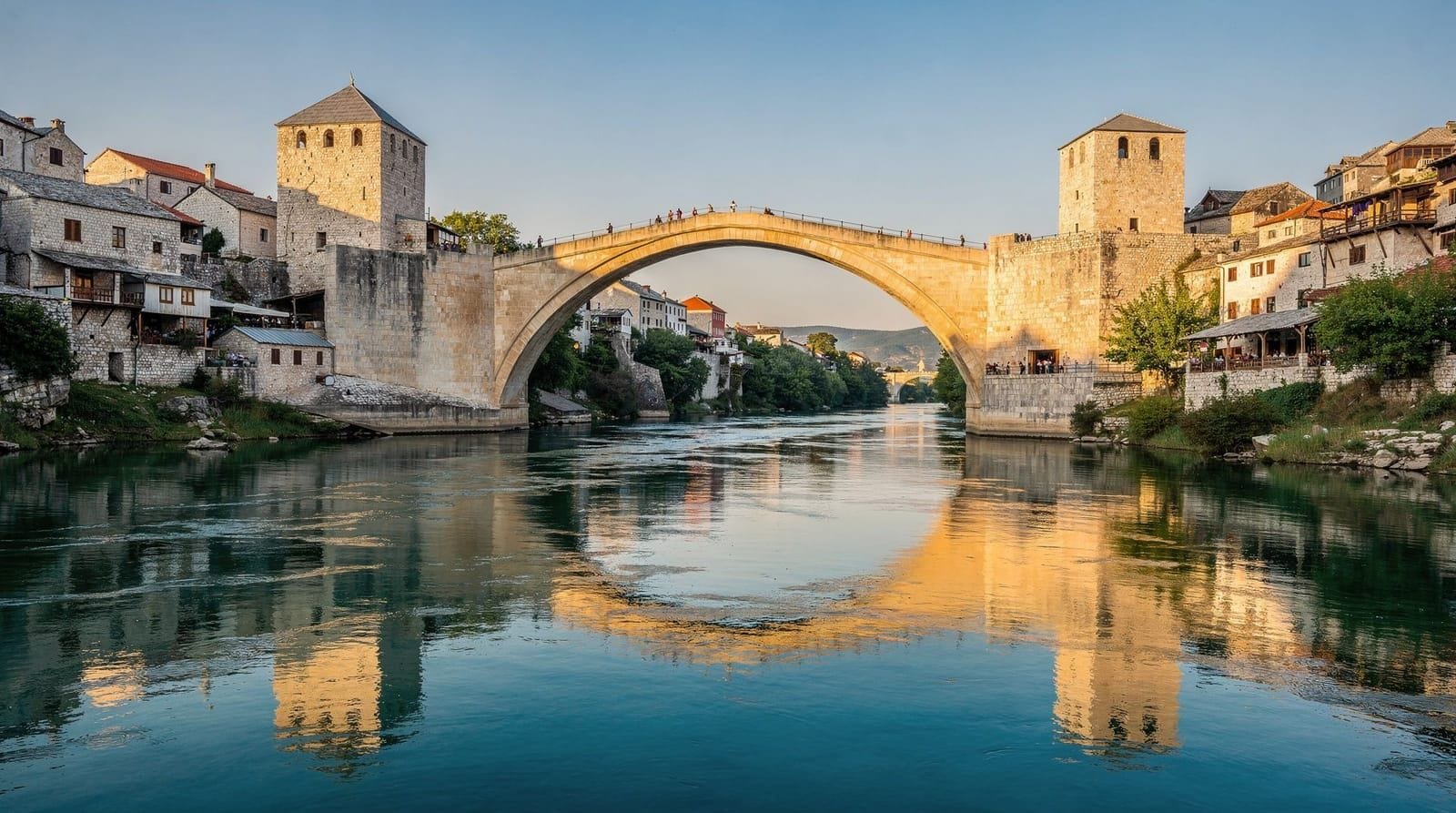
Stari Most — the Old Bridge — is the reason people come. The original 16th-century Ottoman bridge was destroyed during the Bosnian War in 1993 and rebuilt stone by stone, reopening in 2004. It’s beautiful in a way that has everything to do with its context: crossing it, looking down at the turquoise Neretva River far below, with the Ottoman towers on either bank, you’re looking at both a piece of stunning architecture and a monument to rebuilding.
The bridge area is tourist-oriented to a degree that surprises some visitors. The old town’s main cobbled street (Kujundžiluk) is lined with shops selling copperwork, traditional embroidery, and the same souvenirs you’ll find at every Balkan tourist site. The café terraces overlooking the bridge are lovely and expensive (€5–7 for coffee). The bridge divers — young men who jump from the bridge’s crown for donations — perform through the summer.
None of this diminishes the place, but it does mean the crowds in summer are real, and the 11 a.m. to 2 p.m. window is the worst time to be in the old town on a hot day. If you have any control over your timing, arrive at 9–10 a.m. and leave for Kravica by noon.
The specific things worth doing in Mostar beyond the bridge:
The Koski Mehmed Pasha Mosque: entry about €4, you can climb the minaret for a view of the bridge and surrounding rooftops that the street level doesn’t give you. It’s a 15-minute stop.
Lunch: look for restaurants one or two streets back from the main tourist strip. Ćevapi (grilled minced meat in flatbread) is the Bosnian staple and costs €4–6 for a generous portion at a proper local place. Avoid anywhere with laminated picture menus showing falafel and pizza alongside ćevapi.
The east bank: most organised tours stay on the west bank of the Neretva, which is the older tourist circuit. The east bank has working-class restaurants, a lower-key atmosphere, and the view back across the bridge that most photos are taken from. Cross the bridge both ways.
Kravica Waterfalls: absolutely include this
Kravica is 42 km southeast of Mostar, about one hour’s drive (or 1.5 hours on the local bus from Mostar’s main bus station). It’s a horseshoe-shaped waterfall — 25 metres high, 120 metres wide — set in a canyon of green vegetation with a swimming pool at its base.
In July and August, Kravica is genuinely crowded — thousands of visitors daily, a growing network of picnic and bar infrastructure, and the noise of many people cooling off. In September it’s calmer but still operating, and the water is warmer from a summer of sun. The entry fee is around €7–10 per person depending on season.
Swimming at Kravica is the specific thing to do. You jump off the lower rocks (2–3 metres) into the pool at the base of the falls, feel the spray from the waterfall, and swim across to the far bank where the falls hit. It’s excellent. Bring water shoes — the riverbed has slippery rocks — and be aware that the rocks at the base of the waterfall can be crowded at peak times.
Most organised tours include Kravica as a combined stop with Mostar. If you’re driving independently, the road is easy and well-signed from Mostar.
The independent vs organised tour question
Organised tours (typically €50–70 per person from Split, including transport and guide) are the right choice if you:
- Don’t have a rental car
- Prefer to not navigate border crossings independently
- Want context from a guide on the war history of Mostar, which is layered and important
- Are visiting in peak summer and want to avoid parking complications
Independent driving is better if you:
- Want full control of your timing (particularly useful if you want to arrive early and avoid the tour bus rush at Kravica)
- Are already renting a car for the broader trip
- Have done Mostar before and want to explore more at your own pace
The organised tour option from Split is well-run by several operators. Look for small-group tours (12 or fewer people) rather than bus tours — the intimacy of a smaller group makes the Mostar context more meaningful.
A sample day, hour by hour
This is roughly how our second (independent) visit ran, and it’s close to what an organised tour follows too:
| Time | Stop |
|---|---|
| 7:00–7:30 | Depart Split (pickup for tours, or start driving) |
| 9:30–10:00 | Arrive Mostar, cross the Old Bridge, wander the old town |
| 10:00–11:45 | Koski Mehmed Pasha Mosque, the east bank, lunch |
| 12:00–13:00 | Drive to Kravica Waterfalls (around 42 km) |
| 13:00–15:30 | Swim and relax at Kravica |
| 15:30–17:30 | Drive back to Split |
| ~18:00 | Arrive back, tired and happy |
Build in slack either side — border traffic and Kravica parking in July and August can both add 20–30 minutes you won’t get back.
Is it still worth it if you’re also doing Dubrovnik?
Some itineraries try to squeeze in both Mostar and a Dubrovnik day trip from Split on the same week. We’d separate them rather than combine them into one exhausting day — each deserves its own full day, and doing both back to back on consecutive days is genuinely fine if your trip is seven days or longer. If you only have room for one Bosnia-adjacent excursion, Mostar’s Old Bridge and Kravica’s swimming give you more variety per hour than a Dubrovnik day trip, which is mostly walking and viewpoints. Our Mostar destination overview has more on the town itself if you’re deciding whether it earns a full day versus a shorter stop as part of a longer Bosnia-Herzegovina loop through Kravica and the wider day trip.
Driving yourself vs the tour, revisited
If you’re already renting a car for the wider Dalmatian coast, doing Mostar yourself removes almost all of the downside of self-driving — the border crossing is straightforward, parking in Mostar’s old town is signed and easy to find, and you control the Kravica arrival time, which matters more than almost anything else for crowd avoidance. Our car vs no car in Dalmatia guide walks through the wider trade-offs if you haven’t decided yet. If a rental car isn’t already part of your plan just for this one day, the organised tour remains the simpler call.
Book a full-day Mostar and Herzegovina tour from SplitFitting Mostar into the rest of your week
A long day in Bosnia sits best between slower days. If you’re still building your plan, our Split first-timer guide helps you decide what to see before you commit a whole day to the road, and the Split 5-day itinerary shows one way to leave room for it without rushing the rest of the city.
Think about what comes the day after, too. We found it easiest to follow Mostar with something close to base, such as a slow morning in Diocletian’s Palace or a walk up Marjan Hill, rather than another early start. If you’d rather compare the long excursions side by side before choosing, Krka versus Plitvice is a useful companion read, since those are the other big days people weigh against Mostar.
What we’d skip
The souvenir strip on Kujundžiluk. Not worth more than ten minutes. The copperwork is the same as you’ll find in any Balkan market town, and the pressure from vendors is persistent in peak season.
The “traditional Bosnian dinner” extensions some tours offer. Bosnian food is good, but by the time you’ve done Mostar and Kravica, most people are tired and ready to return to Split rather than sit through a extended group dinner.
For the full itinerary that includes an overnight in Mostar rather than a day trip — which we’d recommend if you have seven days and want the night atmosphere of the old bridge — see our seven-day Split to Dubrovnik itinerary.
Frequently asked questions about Mostar in a day from Split
Do I need a visa to cross into Bosnia for the day? No. EU, UK, US, Canadian and Australian citizens cross with just a passport — no visa required for a day trip to Mostar.
Is the Mostar and Kravica combination too much for one day? It’s a full day (around 11–12 hours door to door) but manageable — most of it is driving or relaxed swimming rather than strenuous activity. If you’d rather split it up, an overnight in Mostar via our seven-day itinerary removes the time pressure entirely.
For the Mostar day trip in the context of all Split excursions, our best day trips from Split guide ranks the options.